CFP – Media Justice: Race, borders, disability, data


International Communications Association Preconference, 25 May 2017
Sherman Heights Community Centre, San Diego

CALL FOR PAPERS

Call for the ICA 2017 Pre-Conference “Media Justice: Race, borders,
disability and data,” Sponsored by the Philosophy, Theory and Critique
Division and Communication and Technology  Division of the International
Communication Association

Summary: This is a call for abstracts and session proposals for the Media Justice
pre-conference at the 2017 International Communications Association
meeting in San Diego. The Media Justice pre-conference, to be held on
May 25th, 2017, at the Sherman Heights Community Center in San Diego,
will bring together activists, advocates, and researchers to advance the
shared theory and practice of media justice.

We welcome proposals for academic papers, more informal presentations and panels.

Deadline for proposals: 15 February, 2017 (200 words abstract)

Organisers: Prof Gerard Goggin (University of Sydney), Dr Sasha
Costanza-Chock (MIT), Dr Tanja Dreher (University of Wollongong), Prof
Ricardo Dominguez (UCSD), Maegan Ortiz (Institute of Popular Education
of Southern California)

In the United States, there is an active media justice movement, yet the
concept is rarely used in international academic, activist or advocacy
work. Media justice organizing is based in the realization that social,
racial, gender, disability, cultural, economic, and other forms of
justice require changes in the distribution and control over media and
communications technology (Gregg 2011; Cyril 2005). The Center for Media
Justice explains: “we organize under-represented constituencies for
media rights, access and representation to win social and economic
justice” (http://centerformediajustice.org/about/our-story/our-vision).
Media justice campaigns have focused on media representation, network
neutrality, phone and broadband access, the communication rights of
incarcerated people, policing and surveillance technology, community
media, and public interest cable franchising agreements, among other
areas. Media justice advocates emphasise the struggle against the
broader matrix of domination (Hill Collins, 1990) and links with social
justice movements outside the media field. Given the location of ICA
2017 in San Diego, and the role of the media in the stunning victory for
the Trump campaign’s open appeal to racism, misogyny, homophobia and
transphobia, xenophobia, islamophobia, ableism, and anti-Blackness, this
is the ideal time and place for a preconference on Media Justice.

Hackett describes media activism as ‘the movement of movements,’ and
argues that all social justice movements have an interest in the
transformation of media representations, production processes,
platforms, and policies. Media are addressed as a site of intervention,
rather than merely providing publicity for social justice movements. In
contrast to liberal media reformers, media justice advocates call for
significant structural and institutional changes beyond the tightly
focused field of media policy (Hackett 2011). Media justice advocates
further stress the importance of power redistribution in order to
address past injustices:

Media justice is more than an oppositional framework or simple effort at
political contrast. It is a multi-layered, emerging analysis that draws
on civil and human rights, globalization struggles, corporate
accountability and cultural studies. It starts with a structural
analysis but it doesn’t stop there because media doesn’t stop there. Who
owns it, what’s on it and how it makes us feel are all spheres we must
address simultaneously. Where we go from here has to take into account
where we’ve been and who has been advantages and who has been hurt. And
it is this analysis that separates media justice from the fight for
media democracy, because without a vision that seeks to repair the
impact of the past and the privilege, we’ll have the same old oppression
with better, high-speed resolution. (Makani Themba-Nixon, n.d., cited in
Cyril, 2005: 97).

While some notion of media justice has always been implicit within media
and cultural studies (e.g. the tradition of work on alternative,
citizens,’ and community media), and grassroots organizers have been
developing a praxis of media justice for more than a decade, relatively
little has been published on media justice in either academic or popular
venues.

This pre-conference considers the ways in which recent attention to
race, borders, disability, and data might offer productive resources for
research and practice aimed at media justice. The program brings
together researchers, scholars, activists, and advocates in media
justice organizing in order to advance shared development of theory and
practice. We will discuss questions of justice in regards to media and
communications practices, infrastructures, and representation, as well
as the many ways in which media are vital to wider processes of social
justice and transformation.

We welcome contributions on the following topics (for example):

* Media justice in the time of Trump, Brexit, and resurgent
authoritarian power

* What have we learned from media justice organizing around race and
borders?

* How does thinking from disability challenge and transform ideas of
media justice, communication rights, voice, and listening?

* What are the key challenges for media justice in the age of ‘Big Data?’

* What are the implications of current developments in the
communications infrastructure (especially the internet, including
‘privatised’ networks, the ever expanding surveillance apparatus, the
likely end of net neutrality, etc) – for the above issues?

* How can we further develop a research and advocacy agenda around media
justice?

In order to encourage productive dialogues between communication rights
researchers and practitioners, the program will include invited speakers
from a range of advocacy and activist organisations, and researchers
working on media justice. The program will be facilitated to identify
points of connection, possibilities for ongoing collaborations, and
further development of engaged research and practice.

Deadline for submission of abstracts: 15 February 2017

To submit a proposal, please prepare a title and
200 word abstract; submit your proposal via this form:
http://bit.ly/mj-ica2017-submitabstract.

Please direct any questions to: Prof. Gerard Goggin (University of
Sydney) gerard.goggin@sydney.edu.au, Dr. Tanja Dreher (University of
Wollongong) tanjad@uow.edu.au, or Dr. Sasha Costanza-Chock (MIT)
schock@mit.edu

The Sherman Heights Community Centre is approximately 1.5 miles from the
San Diego Hilton. Participants will have the option of taking a local
bus, a short taxi ride, or walking (approx. 30 mins); we will also
organize transportation at attendee request.
Posted in Uncategorized | Leave a comment

PhD Scholarship: Media and the politics of listening

Deadline for applications: Monday 14 November 2016

A PhD scholarship is available in association with the ARC future Fellowship Project, ‘Listening in’. Successful candidates will be supervised by ARC Future Fellow Dr Tanja Dreher (www.tanjadreher.net). They will be expected to research topics which complement the Future Fellowship research.
Listening in – improving recognition of community media to support democratic participation and wellbeing
New media forms and the community media sector in Australia provide increasing opportunities for diverse communities to speak up, share stories and find a voice. This project analyses the political listening practices necessary to support the potential for voice in this changing media environment. The project contributes to community wellbeing by asking to what extent community media is heard in key mainstream institutions. Case studies examine the ways in which policymakers and journalists listen in to media produced by Indigenous, Muslim and Sudanese Australians. The research engages with Indigenous knowledges, feminist political theory, critical race and whiteness studies to generate policy-relevant analysis of ethical responsiveness to activist and community media.
Potential topics include:

–       impact of Indigenous, community or alternative media
–       listening practices of journalists and/or policymakers
–       the politics of listening in the digital age
–       intersectional or decolonizing strategies for media justice
–       listening in media and political theory
–       media and socio-cultural wellbeing
The Faculty of Law, Humanities and the Arts at the University of Wollongong offers a vibrant, interdisciplinary research environment. Co-supervision possibilities are available across the faculty. The successful HDR candidate will have access to the emerging international network of scholars focused on the politics, ethics and practices of ‘listening’.
Eligibility and Application Details

Applications are invited for commencement in early 2017. PhD scholarship applicants should have attained one of the following qualifications: Honours First Class, a Masters degree by research or equivalent. An Honours degree is a four-year degree which includes a thesis component.  Candidates with lived experience of Indigineity or refugee communities are particularly encouraged to apply.
Both domestic and international prospective students are eligible to apply.
For further information about the project and the PhD scholarship, please contact Tanja Dreher at tanjad@uow.edu.au. Applicants are strongly advised to discuss the application and proposed research project by email with Dr Dreher before submitting an application.
The scholarship stipend for 2017* is approx. $27,000 pa, incremented annually for 3 years. PhD candidates are eligible to apply for faculty conference and fieldwork funding.
Applicants should submit:
a cover letter detailing relevant experience, a CV and an academic transcript to Tanja Dreher at tanjad@uow.edu.au
The deadline for applications is Monday 14 November 2016
Posted in Uncategorized | Leave a comment

PhD Scholarship in Media Studies: Community media and the politics of listening

Deadline for applications: Monday 14 November 2016

A PhD scholarship is available in association with the ARC future Fellowship Project, ‘Listening in’. Successful candidates will be supervised by ARC Future Fellow Dr Tanja Dreher (www.tanjadreher.net). They will be expected to research topics which complement the Future Fellowship research.

Listening in – improving recognition of community media to support democratic participation and wellbeing
 
New media forms and the community media sector in Australia provide increasing opportunities for diverse communities to speak up, share stories and find a voice. This project analyses the political listening practices necessary to support the potential for voice in this changing media environment. The project contributes to community wellbeing by asking to what extent community media is heard in key mainstream institutions. Case studies examine the ways in which policymakers and journalists listen in to media produced by Indigenous, Muslim and Sudanese Australians. The research engages with Indigenous knowledges, feminist political theory, critical race and whiteness studies to generate policy-relevant analysis of ethical responsiveness to activist and community media.
 
Potential topics include:

–       impact of Indigenous, community or alternative media
–       listening practices of journalists and/or policymakers
–       the politics of listening in the digital age
–       intersectional or decolonizing strategies for media justice
–       listening in media and political theory
–       media and socio-cultural wellbeing

The Faculty of Law, Humanities and the Arts at the University of Wollongong offers a vibrant, interdisciplinary research environment. Co-supervision possibilities are available across the faculty. The successful HDR candidate will have access to the emerging international network of scholars focused on the politics, ethics and practices of ‘listening’.

Eligibility and Application Details

Applications are invited for commencement in early 2017. PhD scholarship applicants should have a record of excellent academic performance and have attained one of the following qualifications: Honours First Class, a Masters degree by research or equivalent. An Honours degree is a four-year degree which includes a thesis component. Additional relevant research experience and/or peer-reviewed research activity, awards and/or prizes will be regarded favourably. Candidates with lived experience of Indigenous and refugee communities are particularly encouraged to apply.
 
Both domestic and international prospective students are eligible to apply.
 
For further information about the project and the PhD scholarship, please contact Tanja Dreher at tanjad@uow.edu.au. Applicants are strongly advised to discuss the application and proposed research project by email with Dr Dreher before submitting an application.
 
The scholarship stipend for 2017* is approx. $27,000 pa, incremented annually for 3 years. PhD candidates are eligible to apply for faculty conference and fieldwork funding.

Applicants should submit:
a cover letter detailing relevant experience, a CV and an academic transcript to Tanja Dreher at tanjad@uow.edu.au
 
The deadline for applications is Monday 14 November 2016


Posted in Uncategorized | Leave a comment

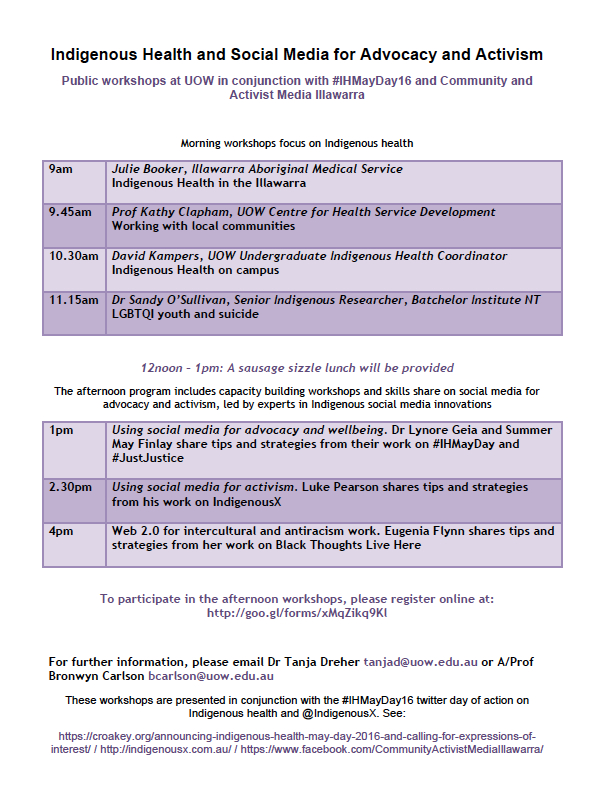
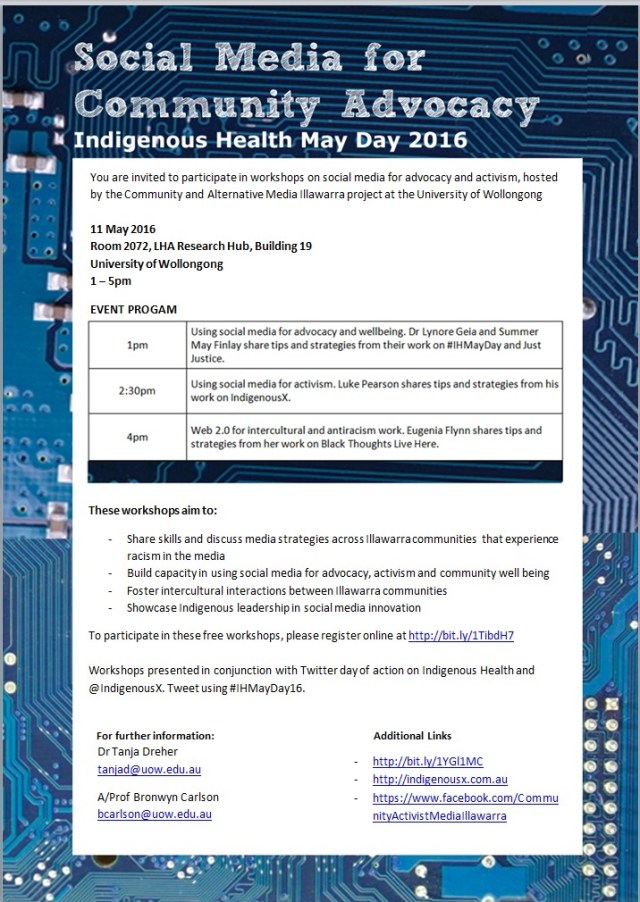
Social Media for Community Advocacy: Workshops at UOW for #IHMayDay16


11 May 2016, LHA Research Hub (19.2072), University of Wollongong

These workshops will provide some practical advice about using social media for advocacy and activism as well as learning from Indigenous people who have extensive experience and expertise in utilising social media platforms to ensure Indigenous perspectives and voices are heard.

Dr Lynore Geia and Summer May Finlay will share their practical experiences and lessons learned in using social media on the #IHMayDay and #JustJustice projects. These campaigns promoted connectivity, community wellbeing and a balanced dialogue privileging Indigenous voices on Indigenous issues. Both campaigns have demonstrated the opportunity social media has afforded Aboriginal and Torres Strait Islander people. Dr Lynore Geia is the founder of IHMayDay, a Senior Lecturer in the School of Nursing and Midwifery and as Centre for Nursing and Midwifery Research Indigenous Futures Research Lead at James Cook University. Dr. Geia is a Palm Island woman, and is passionate about developing an effective praxis in nursing and midwifery between research, education, practice and their impact on health; in particular in Closing the Gap in Aboriginal and Torres Strait Island health. Dr. Geia is a registered nurse and midwife with a family centered health and research focus. Summer May Finlay is a Yorta Yorta Woman who grew up in Lake Macquarie near Newcastle. Summer is an Aboriginal social justice advocate and has worked in Aboriginal affairs for over 10 years in a variety of capacities including youth work, public health policy, Aboriginal and Torres Strait Islander health research, social media and media and communications.

Luke Pearson will discuss his work as the founder of @IndigenousX. Created in 2012, IndigenousX has grown from humble beginnings into an online platform including several social media channels (including IndigenousX Canada – @IndigenousXca, a crowdfunding initiative, a weekly spot in a national paper – the Guardian, and most recently a website publishing weekly stories from Indigenous writers across Australia. Luke Pearson is a Gamilaroi man, teacher, public speaker, and trainer. He is best known as the founder of @IndigenousX, a rotating Twitter account which sees a new Indigenous host take control of the account to tell their own stories in their own words. IndigenousX is also seen in the Guardian’s ‘Comment Is Free’ section where each host is given an opportunity to write their own op-ed piece; IndigenousX is also involved in crowdfunding in partnership with StartSomeGood and has raised over $300,000 to date. More recently, IndigenousX has begun publishing their own content from many Indigenous contributors via indigenousx.com.au.

Eugenia Flynn will showcase her work including through her website, Black Thoughts Live Here. Black Thoughts Live Here is the website of Eugenia Flynn who writes from her view point as an Aboriginal, Chinese, Muslim woman living on Kulin Country in Melbourne, Victoria, Australia. Eugenia is a community arts worker, working with a number of different artists, arts organisations and communities to achieve better outcomes for society through arts and culture initiatives. Eugenia is also a writer and thinker and her work has been published in the Victorian Writer, Peril Magazine, the Guardian Australia, the Conversation Australia and Crikey Online. This year she is the recipient of personal patronage through the Writers Victoria Personal Patrons program.

To participate in the workshops, please register online at: http://goo.gl/forms/xMqZikq9Kl

GetFileAttachment

Posted in Uncategorized | Leave a comment

Invitation: Workshops on Social Media for Community Advocacy @ UOW 11 May 2016

The Community and Alternative Media Illawarra project at the University of Wollongong will host a series of workshops on social media for advocacy and activism, open to the public.

GetFileAttachment

11 May 2016, 1 – 5pm, University of Wollongong

The skills share and capacity building workshops are led by experts in Indigenous social media innovations

Program of workshops:

1pm:  Using social media for advocacy and wellbeing. Dr Lynore Geia and Summer May Finlay share tips and strategies from their work on #IHMayDay and JustJustice

2.30pm:  Using social media for activism. Luke Pearson shares tips and strategies from his work on IndigenousX

4pm:  Web 2.0 for intercultural and antiracism work. Eugenie Flynn shares tips and strategies from her work on Black Thoughts Live Here

The workshops aim to:

  • Share skills and discuss media strategies across Illawarra communities that experience racism in the media
  • Build capacity in using social media for advocacy, activism and community wellbeing
  • Foster intercultural interactions between Illawarra communities
  • Showcase Indigenous leadership in social media innovation

There is no cost to participate in the workshops. Light refreshments will be served.

To participate in 1, 2 or all 3 workshops, please register online at: http://goo.gl/forms/xMqZikq9Kl

For further information on the #IHMayDay@UOW, please click here or email Dr Tanja Dreher tanjad@uow.edu.au or A/Prof Bronwyn Carlson bcarlson@uow.edu.au

These workshops are presented in conjunction with the twitter day of action on Indigenous health and @IndigenousX. See:

https://croakey.org/announcing-indigenous-health-may-day-2016-and-calling-for-expressions-of-interest/ / http://indigenousx.com.au/ / https://www.facebook.com/CommunityActivistMediaIllawarra/

UOW ADMINISTRATION

Posted in Uncategorized | Leave a comment

Listening and amplifying Indigenous voices: #IHMayDay @ UOW 11 and 12 May 2016

On 12 May 2016, UOW will co-host the third annual Indigenous Health May Day Twitter festival, or #IHMayDay16. The focus on the day will be Indigenous youth and families, and suicide prevention.

In previous years, #IHMayDay has trended nationally and provided a vital forum for Indigenous expertise and community-led solutions. In 2015 the event occurred both offline (hosted by Nursing & Midwifery at James Cook University in Townsville) and online, and 2016 will see an expanded real life-meets-cyberspace experience.

As in previous years, the program is for Aboriginal and Torres Strait Islander voices, and non-Indigenous people are encouraged to participate by retweeting and listening.

The theme for the 2016 Twitter festival is youth and families, and suicide prevention. Discussions on the day will be moderated by the founder of #IHMayDay, Dr Lynore Geia from James Cook University, and by A/Prof Bronwyn Carlson and Croakey contributor Summer May Finlay.

You can track the discussions and news at #IHMayDay16.

Leading in to IHMayDay, Wednesday 11 May will feature a program of face to face expert presentations on Indigenous health and skills share workshops on social media for activism and advocacy. To register for the workshops: http://goo.gl/forms/xMqZikq9Kl

11 May Workshops IHMayDay16

Indigenous Health May Day will be of particular interest to students and staff in medicine, health, Indigenous studies, journalism and media studies

The event will be hosted by Associate Professor Bronwyn Carlson, Director of the Forum on Indigenous Research Excellence (FIRE), with her colleague in media studies, Dr Tanja Dreher. UOW’s involvement builds a collaboration between A/Prof Carlson’s ARC-funded research on Indigenous social media use, Dr Dreher’s Future Fellowship research on the politics of listening, and LHA-funded pilot research on Community and activist media in the Illawarra (Dr Sukhmani Khorana, A/Prof Bronwyn Carlson and Dr Tanja Dreher).

Associate Professor Bronwyn Carlson said: “#IHMayDay16 is an extremely important event given we will focus on youth and suicide prevention. Aboriginal and Torres Strait Islander communities experience suicide rates that are among the highest in the world. We are also avid social media users and our participation on social media is at least 20% higher than the national average! Let’s use social media to ensure that important information is shared. As a tool for action, social media provides us with a forum within and across territorial borders where our voices can be heard and where we can communicate, network, educate, share and challenge. Join us and be part of this initiative!”

Dr Tanja Dreher said: “#IHMayDay is such an important event, not least for the invitation for non-Indigenous people to participate by listening and RT-ing. I hope to learn more about the politics and practices of listening by working with #IHMayDay16. Hosting the event at the University of Wollongong is also an opportunity to showcase local expertise on Indigenous health and the many organisations doing fantastic work across the Illawarra.”

Dr Lynore Geia said: “I am thrilled that #IHMayDay16 is our third such event. For me, it’s about reaching out into national and international arenas, and talking about the issues of Indigenous health in Australia in its holistic sense. It’s about collaboration and developing genuine partnerships; it’s about moving forward. It’s so much more than a talkfest – it’s about building communities that want to see positive outcomes for Indigenous people and for our nation more widely.”

Summer May Finlay said: “To me, #IHMayDay16 is one day where Aboriginal and Torres Strait Islander people’s voices are privileged. I hope that people reflect on the dominance of non-Indigenous people’s voices on issues affecting us and consider how they can ensure that they don’t speak for us, over us or instead of us.”

For further information please contact bcarlson@uow.edu.au or tanjad@uow.edu.au

IHMayDay 2016 is co-hosted with the Croakey social journalism project (croakey.org)

For more information on #IHMayDay16: https://croakey.org/announcing-indigenous-health-may-day-2016-and-calling-for-expressions-of-interest/

Posted in Uncategorized | Leave a comment

Workshops on ‘Listening as a feminist intervention’

Tuesday 19 April, 2016

Convened by Tanja Dreher

Hosted by the Feminist Research Network at the University of Wollongong


Works in progress roundtable: Listening as feminist politics

The morning roundtable traces the diverse feminist antecedents and influences for an emerging interest in political ‘listening’ in media studies and political theory. The transformative potential of voice as a strategy to challenge marginalisation has been a mainstay of feminist politics and research. Yet feminist critical engagements address voice as a site of struggle (rather than unqualified celebration), which entails concern with the problems of listening and response as much as expression and representation. We will explore the ways in which attention to ‘listening’ has developed as a feminist-inspired intervention in political theory, as a contribution to longstanding debates on speaking positions, and as a reframing of debates on the public/private and media histories. In the context of recent arguments that the turn to listening need not necessarily entail a feminist politics, we foreground the asides and traces of earlier calls for attention to listen, and recupe the legacy of listening interventions in diverse feminisms, broadly defined.

Speakers: Cate Thill (Notre Dame), Justine Lloyd (Macquarie), Tanja Dreher (UoW), Nicole Matthews (Macquarie)

Discussant: A/Prof Joan Kirkby (Macquarie)


Listening as feminist pedagogy

The afternoon workshop aims to generate discussion and practical strategies for working with ‘listening’ as a feminist-inspired practice in our teaching. Speakers will introduce their experiences with various ‘listening’ exercises in university teaching, in order to stimulate discussion of these and other possibilities for listening interventions.

Speakers: Elaine Laforteza (UTS), Nisha Thapliyal (Newcastle), Denise Buiten (Notre Dame), Colleen McGloin (UoW), Andrew Whelan (UoW)


For further information or to RSVP, please email: tanjad@uow.edu.au

Posted in Uncategorized | Leave a comment

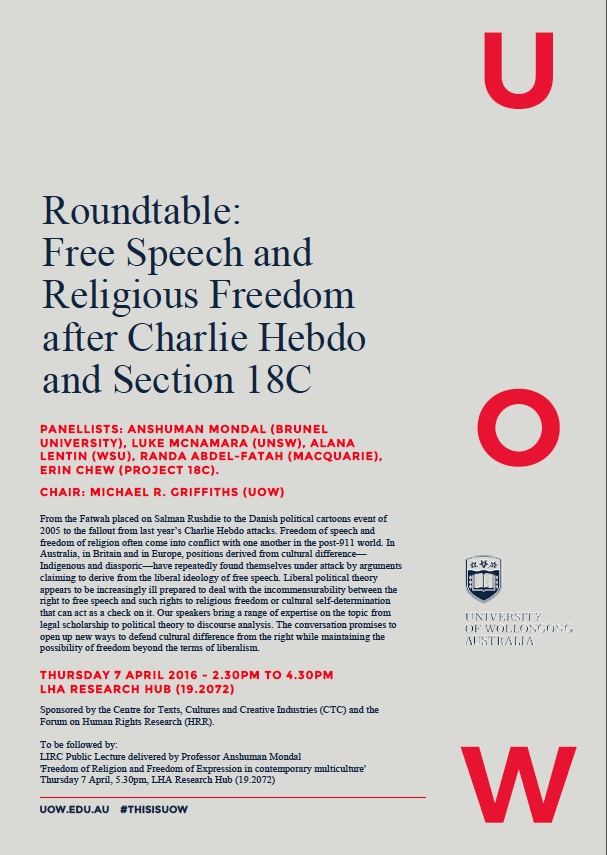
Free Speech and Freedom of Religion: UOW 7 April 2016

On Thursday 7 April 2016 there will be two events at The University of Wollongong on the theme of Free Speech and Freedom of Religion – a Roundtable (2.30 – 4.30pm) and the LIRC Public Lecture (5 for 5.30pm)

Roundtable

The Roundtable is followed by the LIRC Public Lecture

Freedom of Religion and Freedom of Expression in contemporary multiculture
Date:          Thursday 7 April 2016
Time:         5:00pm drinks, Lecture commences at 5:30pm
Location:   Research Hub (19.2072)
RSVP:            Online for lecture only
Abstract: Recent freedom of speech controversies involving religious groups have established a widespread public impression that the right to freedom of expression and the right to religious freedom are in tension if not outright opposition. And yet, in every single human rights charter they appear side by side, as successive articles. Is this adjacency coincidental or merely conceptual? This lecture will argue that it is not, that their proximity to one another is historical and, in exploring this history, we can see that the contemporary view that they are in tension is relatively recent. Looking at how the First Amendment of the US Constitution came into being, it is possible to show how, over the course of two centuries, shifts in the understanding of each liberty has profoundly formed and shaped understandings of the other. The lecture will finish with some reflections on the implications of the contemporary view about these liberties and their effects on the inhabitants of multicultural liberal-democracies, especially religious minorities.
Biography:  Anshuman A. Mondal is Professor of English and Postcolonial Studies at Brunel University London, UK. He is the author of four books, including Islam and Controversy: The Politics of Free Speech after Rushdie (Palgrave, 2014) and many essays, journal articles and book chapters on cultural politics, identity, religion and multiculturalism.


Posted in Uncategorized | Leave a comment

Colloquium: ‘Ethical Responsiveness: listening and reading across difference’

Friday 18 March, University of Wollongong

Convened by Dr Tanja Dreher (ARC Future Fellow)

Sponsored by the Faculty of Law, Humanities and the Arts in conjunction with Future Fellowship project ‘Listening In’ (FT140100515), and a UoW Visiting International Scholar Award (Prof Anshuman Mondal, Brunel)

Colloquium Program Ethical Responsiveness

This colloquium explores the productive possibilities of moving beyond the politics of voice or representation to explore listening and reading across difference in research and in advocacy work. To develop the emerging scholarship on political listening and reading, we ask what can be learned from critical scholarship on negotiating difference, alter politics, ally and solidarity work, or decolonisating strategies? Presenters will also engage recent work on rethinking recognition and the limits of liberal free speech theory. The colloquium brings together researchers from a range of disciplines and approaches to generate new conversations on the ethical possibilities and pitfalls of listening and reading.

Speakers: Anshuman Mondal (Brunel), Tanja Dreher (UoW), Shakira Hussein (Melbourne), Sukhmani Khorana (UoW), Clare Land (Victoria University), Lisa Slater (UoW), Anna Szorenyi (Adelaide), Cate Thill (Notre Dame), Lisa Waller (Deakin), Allison Weir (ACU), Shinen Wong (Asian Australian Democracy Caucus)

For further details or to register for participation, please email tanjad@uow.edu.au

Posted in Uncategorized | Leave a comment

PhD Scholarships in Media Studies: Community media and the politics of listening

Deadline for applications: Wednesday 17 November 2015

Up to two PhD scholarships are available in association with the ARC future Fellowship Project, ‘Listening in’. Successful candidates will be supervised by ARC Future Fellow Dr Tanja Dreher. They will be expected to research topics which complement the Future Fellowship research.

Listening in – improving recognition of community media to support democratic participation and wellbeing

New media forms and the community media sector in Australia provide increasing opportunities for diverse communities to speak up, share stories and find a voice. This project analyses the political listening practices necessary to support the potential for voice in this changing media environment. The project contributes to community wellbeing by asking to what extent community media is heard in key mainstream institutions. Case studies examine the ways in which policymakers and journalists listen in to media produced by Indigenous, Muslim and Sudanese Australians. The research engages with Indigenous knowledges, feminist political theory, critical race and whiteness studies to generate policy-relevant analysis of ethical responsiveness to activist and community media. .

Potential topics include:

  • impact of Indigenous, community or alternative media
  • listening practices of journalists and/or policymakers
  • the politics of listening in the digital age
  • intersectional or decolonizing strategies for media justice
  • listening in media and political theory
  • media and socio-cultural wellbeing

The Faculty of Law, Humanities and the Arts at the University of Wollongong offers a vibrant, interdisciplinary research environment. Co-supervision possibilities are available across the faculty. The successful HDR candidates will have access to the emerging international network of scholars focused on the politics, ethics and practices of ‘listening’.

Eligibility and Application Details

Applications are invited for commencement in early 2016. PhD scholarship applicants should have a record of excellent academic performance and have attained one of the following qualifications: Honours First Class, a Masters degree by research or equivalent. An Honours degree is a four-year degree which includes a thesis component. Additional relevant research experience and/or peer-reviewed research activity, awards and/or prizes will be regarded favourably. Candidates with lived experience of Indigenous and refugee communities are particularly encouraged to apply.

Both domestic and international prospective students are encouraged to apply.

For further information about the project and the PhD scholarships, please contact Tanja Dreher at tanjad@uow.edu.au. Applicants are strongly advised to discuss the application and proposed research project by email with Dr Dreher before submitting an application.

The scholarship stipend for 2015* is AUD $25,849pa, incremented annually for 3 years.

 Applicants should submit:

  1. a cover letter detailing relevant experience, a CV and an academic transcript to Tanja Dreher at tanjad@uow.edu.au
  1. a full Higher Degree Research (HDR) admission application including a UOW Scholarship application via https://www.uow.edu.au/apply/index.html. The application should include an academic transcript, copy of passport or birth certificate and an outline of your proposed research project. In the Scholarship Details Section applicants should select ‘Other UOW Funded Scholarship’ and include the name of the Future Fellow (Dr Tanja Dreher) and the grant ID number (FT140100515)

The deadline for applications is Wednesday 17 November 2015

*2016 figure not yet released

Posted in Uncategorized | Leave a comment